
Software testing is far more than executing test cases – it’s a strategic discipline shaped by diverse mindsets that uncover, prevent, and anticipate issues across the entire software lifecycle.
The Strategic Perspective of Software Testing
Software testing is often misunderstood as a process solely focused on executing test cases and identifying defects. However, experienced testers recognize that effective testing is not merely about running scripts or logging bugs – it is a discipline that integrates critical thinking, strategic analysis, and creative problem-solving. Testing, at its core, is a mindset, a unique way of approaching software quality that extends far beyond functional validation.
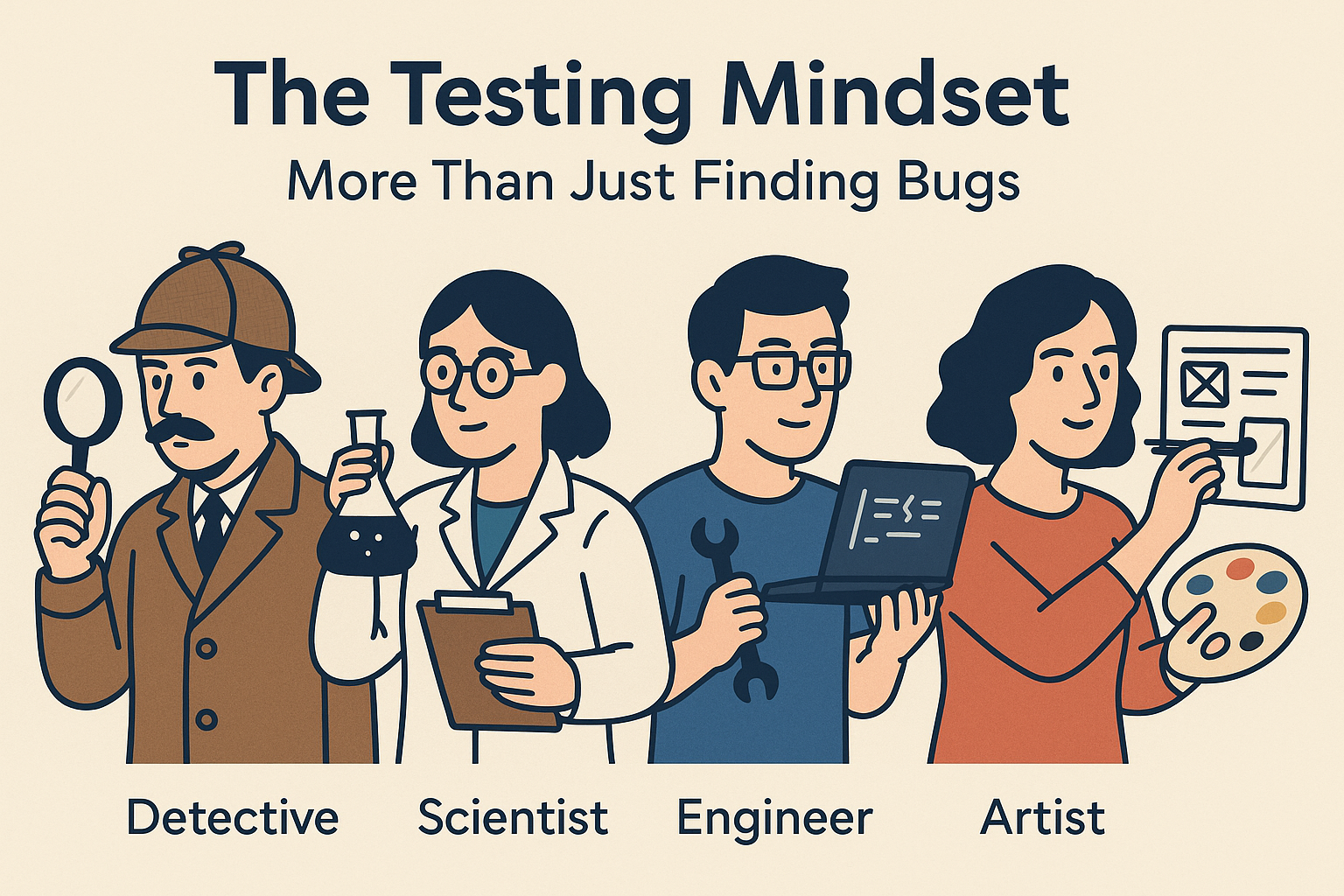
Throughout the evolution of software testing, professionals have adopted different approaches, each shaped by their expertise and perspective on quality assurance. These varied approaches can be categorized into four key testing mindsets: the Detective, the Scientist, the Engineer, and the Artist. Each mindset brings unique strengths to the testing process and contributes to a comprehensive quality strategy.
The Detective: Uncovering Hidden Defects
One of the most valuable skills a tester can develop is the ability to think like a detective. This mindset is driven by curiosity, persistence, and an analytical approach to uncovering software defects that might otherwise go unnoticed.
Detective-minded testers leverage multiple sources of information – log files, user feedback, monitoring tools, and historical defect data – to piece together patterns and uncover deep-seated issues. They recognize that software failures often have subtle, interconnected causes rather than being isolated incidents.
By systematically investigating anomalies, these testers identify potential risks before they escalate into critical failures. They apply root cause analysis, examining past defects and correlating them with new ones, to ensure similar issues do not reoccur. Moreover, they develop an intuition for spotting vulnerabilities by questioning assumptions and exploring edge cases. In a fast-paced development cycle, where efficiency is paramount, detective-style testers add immense value by ensuring that seemingly minor inconsistencies are thoroughly examined, mitigating risks that could compromise system integrity.
The Scientist: Hypothesis-Driven Testing
Testing, when executed effectively, is not a mere checklist-based verification process – it is a structured experiment. The Scientist mindset in software testing follows the principles of hypothesis-driven validation, ensuring that tests are designed with clear objectives and measurable outcomes.
Testers with a scientific approach construct hypotheses about system behavior, failure patterns, and performance characteristics. They develop structured experiments, controlling variables and analyzing test results to refine their understanding of the software. This mindset is particularly crucial in exploratory testing, performance testing, and AI-driven test strategies, where empirical data is essential to draw meaningful conclusions.
For example, rather than running arbitrary tests, a scientist-minded tester may hypothesize that a specific API call might degrade under high concurrency. They would then design controlled load tests, gather empirical data, and use statistical analysis to validate or refute their assumption.
By integrating this experimental approach, testers improve defect prediction accuracy, enhance risk-based testing, and contribute to a culture of continuous learning and refinement within their teams.
The Engineer: Building Resilient Test Environments
While identifying defects is crucial, preventing them is even more valuable. Testers with an Engineer mindset focus on strengthening the foundations of software quality through automation, infrastructure reliability, and process optimization.
An engineer-minded tester goes beyond test execution to architect robust testing frameworks, implement scalable test automation, and integrate testing into CI/CD pipelines. They emphasize testability as a design principle, collaborating with developers to ensure that code is inherently verifiable.
These testers are also deeply involved in performance engineering, ensuring that test environments accurately reflect real-world conditions. They utilize virtualization, containerization, and cloud-based test setups to optimize test coverage across different environments.
Security testing is another domain where the engineer mindset is invaluable. Testers who think like engineers proactively identify vulnerabilities by employing security testing methodologies such as penetration testing and threat modeling.
By integrating engineering best practices into testing, these professionals contribute to a sustainable, scalable, and efficient testing ecosystem, enabling rapid yet reliable software delivery.
The Artist: UX-Focused Exploratory Testing
Beyond functional correctness, software quality is deeply intertwined with user experience. Testers who embrace the Artist mindset approach testing from the perspective of end users, focusing on usability, accessibility, and overall user satisfaction.
These testers engage in exploratory testing with a focus on intuitiveness, responsiveness, and user journey friction points. They simulate real-world interactions, identifying areas where users may experience frustration or confusion.
The artist-minded tester does not merely validate whether a feature works – they evaluate how seamlessly it integrates into the user’s workflow. They advocate for intuitive design, collaborating with UX designers and product managers to refine interfaces, optimize accessibility, and enhance overall user engagement.
A key strength of this mindset is adaptability. Unlike rigid test scripts, artistic testing involves freeform exploration, leveraging creativity to discover unique edge cases that structured tests might overlook. This mindset is particularly valuable in industries where user experience is a competitive differentiator, such as mobile applications, e-commerce platforms, and SaaS products.
By incorporating UX-focused exploratory testing, testers ensure that software not only meets technical specifications but also delivers an intuitive and frictionless user experience.
Elevating Software Quality Through a Multifaceted Testing Approach
Each of these mindsets – the Detective, the Scientist, the Engineer, and the Artist – brings distinct strengths to software testing. However, the most effective testers do not confine themselves to a single approach. Instead, they adopt a hybrid strategy, dynamically shifting between mindsets based on the context of the project, the nature of the application, and the specific risks involved.
Organizations that foster a diverse testing culture, encouraging testers to develop multiple perspectives, gain a strategic advantage in software quality assurance. By combining investigative thinking, scientific rigor, engineering discipline, and artistic intuition, testers can elevate software quality beyond traditional defect detection – ensuring resilience, usability, and long-term maintainability.
Which testing mindset resonates most with you? Are you a methodical detective, a hypothesis-driven scientist, a systems-focused engineer, or a creative artist? Perhaps you embody all four in different aspects of your work. Embracing these diverse perspectives will help shape the future of software testing, driving innovation and excellence in software quality assurance.