
For years, a quiet frustration has simmered within the software testing community. A recent post, written by one of Testuff’s founders, resonated with many by giving it a name: “The Illusion of Progress.” It argued that despite two decades of advancements in software development, from Agile and DevOps to CI/CD and the cloud, the core practices and tools of quality assurance haven’t fundamentally evolved. We’ve gotten faster at running the same old tests, but we haven’t gotten fundamentally smarter about quality itself.
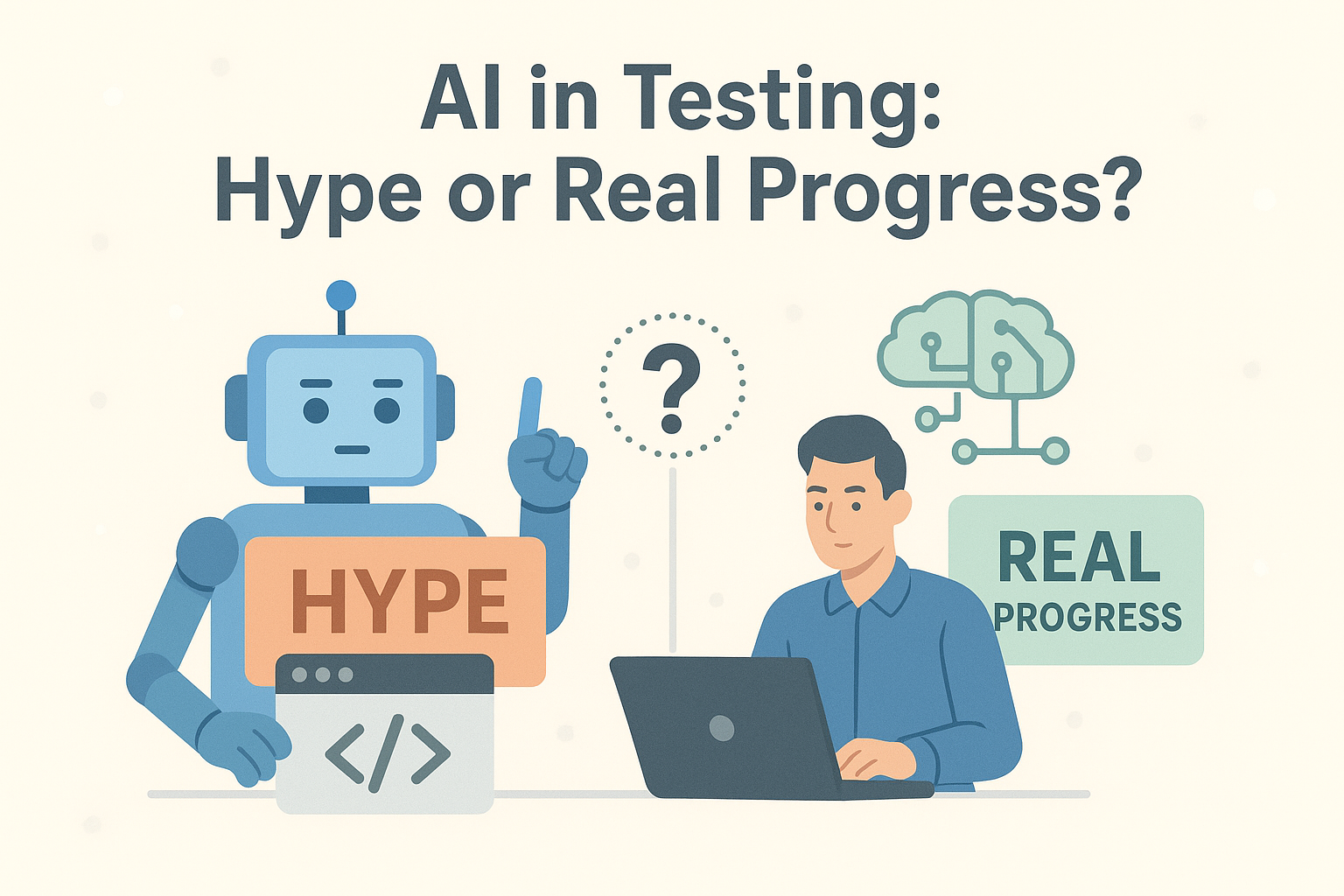
Into this landscape of perceived stagnation, a new hero has emerged, promising to shatter the old paradigms: Artificial Intelligence.
AI is positioned as the force that will finally deliver the progress we’ve all been waiting for. It promises autonomous test creation, self-healing scripts that never break, and intelligent analysis that can predict bugs before they happen. Vendors and evangelists paint a picture of a future where tedious manual work is eliminated, and quality is a seamless, automated byproduct of development.
The hope is palpable. But after years of chasing buzzwords, we must ask the critical questions: Is AI delivering on this promise already? Or are we simply trading one illusion of progress for another, more sophisticated one?
The Seductive Promise: Why We Want to Believe in AI
The appeal of AI in testing is undeniable because it targets our deepest pain points. The vision is compelling:
- Autonomous Test Generation: Imagine an AI that can scan an application, understand its user flows, and automatically generate a comprehensive suite of functional and integration tests. This would slash the time spent on manual test case design (a bottleneck in many Agile sprints).
- Self-Healing Automation: Test automation’s Achilles’ heel has always been maintenance. A simple change to a UI element’s ID can break dozens of scripts. AI promises “self-healing” tests that can intelligently identify when an element has changed and update the locator on the fly, dramatically reducing maintenance burden.
- Predictive Quality Analysis: By analyzing historical data from code commits, bug reports, and test results, AI models could predict which areas of an application are most at risk for new defects. This allows QA teams to focus their resources where it matters most which is moving from reactive to proactive testing.
- Intelligent Visual Validation: AI can go beyond simple pixel comparisons to identify meaningful visual regressions, catching UI bugs that traditional automation would miss while ignoring noise from dynamic content.
This isn’t just a fantasy; early versions of these tools exist. And for many, this vision represents the true “shift left”: a world where quality is woven into the fabric of development by intelligent, autonomous agents.
The Reality on the Ground: Is It Here Already?
While the promise is grand, the current reality of AI in testing is far more modest. If you strip away the marketing jargon, today’s AI acts less like a revolutionary force and more like a clever assistant.
The core challenge that AI has yet to solve is the “Oracle Problem.” A test oracle is the mechanism by which you determine if a test has passed or failed. You need a source of truth to know what the correct outcome should be. An AI can learn to drive an application and interact with its elements, but it doesn’t possess the contextual understanding or business knowledge to know if the application’s behavior is correct. It can tell you a button is blue but not if it should be blue.
- “Self-healing” is often just “better locators.” While useful, most mechanisms can fix broken tests but can’t tell you if the change that broke them was intentional or a bug – risking false confidence.
- Autonomous generation creates quantity, not necessarily quality. AI can generate hundreds of tests but often lacks intent and coverage of complex business rules.
- AI is data-hungry and biased. Predictive models require clean, structured, historical data, often unavailable or inconsistent in real-world QA environments.
For now, AI is a powerful tool for augmenting human testers – not replacing them. It can accelerate script creation, maintenance, and analytics, but strategic thinking and judgment remain human territory.
The Future of Quality: Will It Get There?
The fact that AI isn’t a silver bullet today doesn’t mean it won’t be transformative. The real progress won’t come from removing humans, but from combining the strengths of both human and machine intelligence.
In this future, AI will handle the tasks machines excel at such as processing massive datasets, identifying patterns, and repetitive execution, freeing testers to focus on:
- Strategic Risk Analysis: Using AI-generated data to craft smarter, risk-based test strategies.
- Complex Exploratory Testing: Leveraging human intuition and curiosity to uncover subtle, real-world bugs that automation would miss.
- Ethical and Usability Testing: Addressing fairness, bias, and user experience – inherently human-driven concerns.
The real evolution isn’t about replacing testers but elevating them. Transforming QA professionals into quality strategists, data analysts, and user advocates, using AI as an amplifier for human expertise.
Conclusion: The Real Progress of AI in Testing
So, is AI the progress we’ve been waiting for? The answer is a nuanced yes. It’s not the turnkey solution that will solve everything overnight, believing that would be falling for a new illusion of progress. The real advancement lies in how we evolve our skills, mindset, and collaboration with intelligent systems.
The question is no longer if AI will change testing, but how we will adapt to harness its power responsibly and intelligently.