
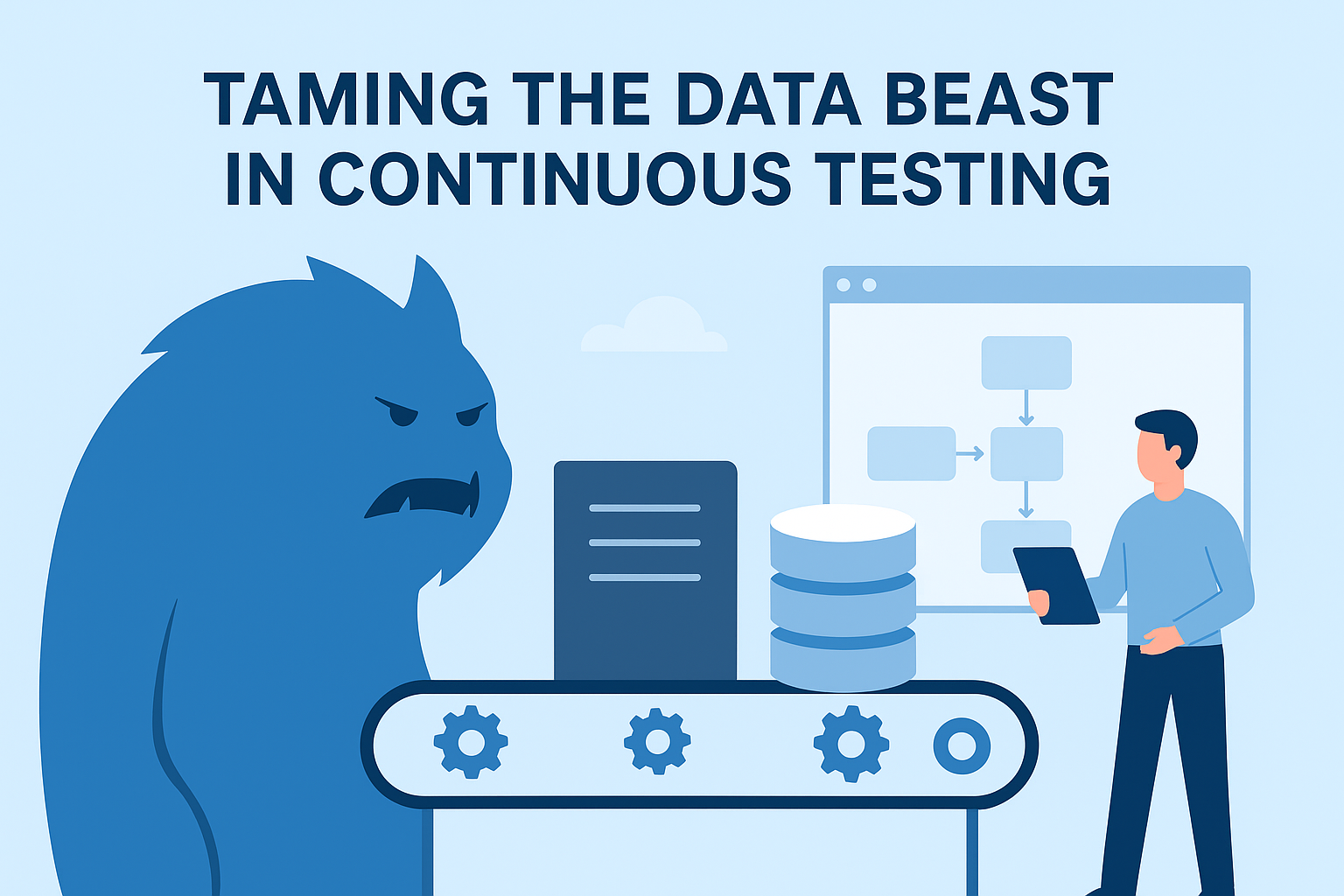
Taming the Data Beast in Continuous Testing

When the build pipeline turned red for the third time that week, Lena, a senior QA engineer, already knew what had gone wrong. It was not a bad merge, a flaky test, or a missing dependency. The problem was test data again.
An expired token, mismatched user profile, and stale records from a previous deployment had derailed the integration suite. The developers complained that QA was slowing down the pipeline. The testers argued that the environments were not ready for validation. The release manager stared at the CI dashboard, watching another deployment slip away.
This scene repeats itself in countless engineering teams that aim for continuous delivery. They automate builds, deployments, and tests, yet they often underestimate the silent bottleneck that threatens the entire pipeline: poor test data management.
The Data Problem in Continuous Testing
In earlier testing models, data was static. A single database snapshot or spreadsheet would support months of testing. Continuous delivery changes that completely. Software evolves daily, APIs change, schemas are refactored, and microservices may be at slightly different versions at any moment. Data that worked yesterday can fail every test today.
Many QA teams report that roughly one third of their failed tests come from inconsistent or outdated data rather than genuine code issues. The damage goes beyond test failure rates. It erodes confidence in automation, increases maintenance overhead, and often forces teams to waste valuable time debugging data instead of validating functionality.
Redefining Test Data Management
Test Data Management, or TDM, has existed for decades, but its role in modern pipelines is far more dynamic. In a continuous delivery context, TDM is not just the storage of test databases. It is an automated discipline that involves creating, versioning, provisioning, and cleaning test data with the same rigor used for code.
Good TDM addresses several difficult questions. How can we generate realistic but safe data? How do we synchronize datasets across changing schemas? How can the data automatically refresh during each build without slowing the pipeline? How do we stay compliant with privacy regulations while keeping test results reliable?
The key principle is that test data must become a managed artifact, tracked and versioned just like code and configuration.
Treating Data as Code
In a mature continuous delivery system, every artifact in the pipeline is defined in code. Infrastructure is code, deployments are code, and now data can also be code.
When teams treat test data this way, they store it in version control alongside tests and configurations. Each test suite references the correct data version. When a schema changes, the same pull request can include a corresponding data update. If the pipeline fails, developers can reproduce the issue locally using the same dataset that triggered it. Even rollback scenarios can now include a return to a previous data version.
This approach introduces transparency and repeatability. It also removes the mystery of what data was used, a question that often slows triage during a failed build.
Synthetic Data and Privacy
Modern QA teams face another challenge: privacy and compliance. Regulations such as GDPR and HIPAA make it risky to copy production data into testing environments. Simple anonymization can help, but it is not always enough. Poorly masked data may still reveal private details, while completely synthetic data may lack the complexity of real-world patterns.
The best solutions blend both ideas. Synthetic data generation tools, sometimes enhanced by AI, can model the statistical structure of production data and create realistic, compliant datasets. These AI-based systems learn relationships between entities, constraints, and value distributions, then replicate them without exposing personal information.
When applied correctly, this produces data that behaves like production but remains ethically and legally safe. Testers must review and validate AI-generated datasets carefully. Blindly trusting an AI generator can lead to unrealistic or biased data that hides edge cases rather than revealing them. Human oversight remains essential.
The Role of AI in Creating and Managing Test Data
Artificial intelligence has rapidly become a valuable partner in modern TDM. AI can analyze existing production data to identify patterns, correlations, and anomalies. It can then use those insights to generate synthetic records that mimic actual behavior. It can also detect coverage gaps by comparing existing test data against real user flows or production logs.
For example, AI can identify that ninety percent of test data covers common user types but only two percent includes specific regional configurations or mobile-only behaviors. The system can then propose new data combinations that increase coverage for underrepresented scenarios.
AI can also automate test data cleanup by detecting unused datasets, obsolete schemas, or duplicated entries. When integrated into a continuous testing pipeline, this intelligence keeps test data fresh and relevant without requiring manual intervention. In the future, AI will likely predict which data combinations are most likely to reveal critical defects, guiding QA teams to test smarter rather than harder. AI remains a collaborator, not a replacement for human judgment.
Automating the Data Lifecycle
A reliable continuous delivery pipeline manages data like any other resource: provision, use, and dispose. Each test stage, whether unit, integration, or end-to-end, should begin with clean and appropriate data. Once the tests finish, the system should discard or refresh it automatically.
This approach prevents data pollution, where leftover state from previous runs causes unpredictable results. Many teams spin up ephemeral environments for each build, complete with seeded databases. Containers or infrastructure-as-code scripts can automate this process so that every run starts from a known, consistent baseline.
Where Test Management Adds Value
Test management tools often operate behind the scenes in this process, but they provide crucial visibility. While TDM ensures data integrity, test management ensures traceability. Platforms such as Testuff can link specific test cases to the datasets they depend on, making it possible to analyze failure patterns or identify when a data change affects multiple suites.
The result is a more predictable testing process. QA teams no longer waste time guessing which version of the dataset was used. They can make informed decisions based on evidence. This kind of structured insight is what separates ad hoc testing from disciplined continuous quality.
The Cultural Aspect of Test Data Management
Technology alone cannot solve data chaos. True improvement requires a shared understanding that data management is a collective responsibility. Developers should design APIs and schemas with testability in mind. Testers should advocate for regular data refresh cycles and compliance checks. Operations should automate environment setup and data provisioning as part of deployment scripts.
Some teams appoint a data steward whose role is to maintain these standards. This is not bureaucracy but engineering hygiene. It keeps the flow stable, reduces pipeline fragility, and allows everyone to focus on product quality rather than firefighting.
Looking Ahead
As continuous delivery becomes the norm, test data management will evolve into an even more intelligent, automated system. Real-time production analytics will feed anonymized usage patterns into test environments. AI will forecast which datasets correlate with higher defect discovery and automatically create them for future runs.
We are already seeing early signs of this with modern test management platforms such as Testuff, which combine test analytics with AI-driven insights. These features highlight low-value or redundant tests, many of which originate from poor data quality or duplication. This loop between test management and intelligent data creation will redefine how QA ensures reliability at scale.
The Continuous Flow
Back in Lena’s team, a few months after adopting automated and versioned test datasets, the build pipeline finally runs without interruption. Failures still happen, but now they reflect real defects instead of data mismatches. The delivery rhythm has become steady again, and the confidence in the testing process has returned.
Continuous delivery is only as continuous as the data that supports it. When test data becomes a managed, traceable, and intelligent part of the pipeline, quality stops being an obstacle and becomes an outcome of design.