
When AI Tests Pretend to Work
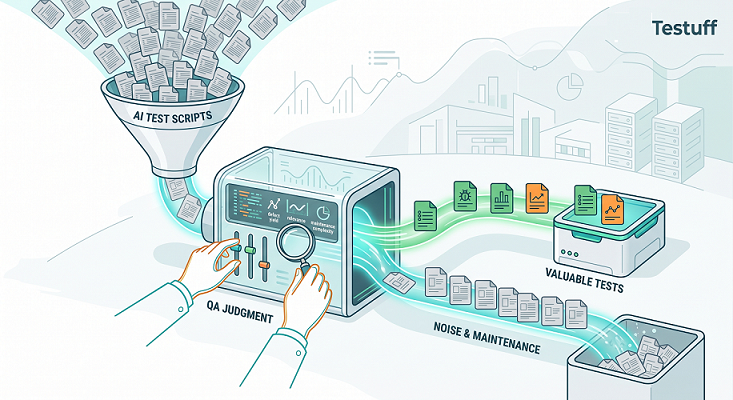
For years on this blog, we talked about the pain of not having enough tests. QA teams were always racing against the clock, trying to write scripts before the release ship sailed, worrying about what was slipping through the cracks.
Now the problem is flipped upside down.
Give an AI agent a set of API docs or a user story, and it will throw hundreds of test scripts at you in five minutes. It feels like magic until you look closely at what those scripts are actually doing.
When Passing Tests Tell Lies
A lot of these generated scripts act like glorified cheerleaders. They open a browser, click through a form, check that the page returned a 200 status code, and call it a day. The build pipeline turns green. Management looks at the coverage report and smiles.
The problem is that the test did not actually check anything meaningful. Take a simple checkout flow as an example. The AI script fills in a name, pastes a fake credit card number, hits submit, and checks that a thank you message popped up on the screen.
That looks fine on paper. But what if the promo code discount failed to calculate, or the backend quietly charged the user the wrong amount? The UI still showed a confirmation page, so the test passed. The feature could be completely broken for a paying customer, but your pipeline green-lights the deployment anyway. When you generate tests at scale without strict verification, you do not get better software quality. You just get louder noise.
Syntax Without Context
An AI model understands code syntax, but it does not understand your business logic. It does not know that a user in Germany needs different tax calculations than a user in California. It does not know that disabling a user account should instantly revoke active session tokens across three microservices.
Because the machine lacks this context, it defaults to testing happy paths over and over with slight variations. It might generate twenty tests that check if a login form accepts valid email formats, while completely ignoring what happens when a user logs in with an expired token during a database failover. The coverage numbers go up, but actual risk reduction stays flat.
Filtering Signal from Noise
So how do you separate useful AI tests from pure clutter?
One of the most practical methods is mutation testing. You intentionally break a line of code in a staging environment, like flipping a logic operator or breaking a calculation, and see if the AI suite notices. If the model generated forty test variations for your cart service, but thirty-five of them still pass when you quietly disable the discount logic, throw those thirty-five tests away. They are just taking up compute time.
You also have to account for the maintenance bill. If a developer renames a CSS class on a primary button and fifty AI-generated scripts fail in CI, that is not automation helping your team. That is a tax on your engineering velocity.
When a test suite constantly breaks over superficial changes, developers stop paying attention to test failures. They start re-running the pipeline three times hoping it goes green, or ignoring alert channels. The moment your team starts treating red builds as minor annoyances instead of actual warnings, your test suite has failed its primary job.
The Auditing Imperative
This is why the role of a test management platform is changing so drastically. It cannot just be a bucket where you store manual test steps anymore. It has to act as an audit system for your automated tools. You need a clean way to track which tests were written by humans who knew the system context, which were generated by AI, which ones actually catch bugs, and which ones waste your time.
Fast test generation is impressive, but fast useless tests just get you to a broken release quicker. As testing tools get smarter, the value of human judgment goes up, not down. The goal was never to run more tests. The goal was always to ship software that works.