
For years, the software industry has focused on one goal above almost everything else: increasing development speed. We have spent decades removing friction from the process of building software. Development environments improved, deployment pipelines became automated, cloud infrastructure eliminated provisioning delays, and test automation dramatically reduced the time required to validate changes. Every major advancement promised to help teams move faster, and most of them delivered.
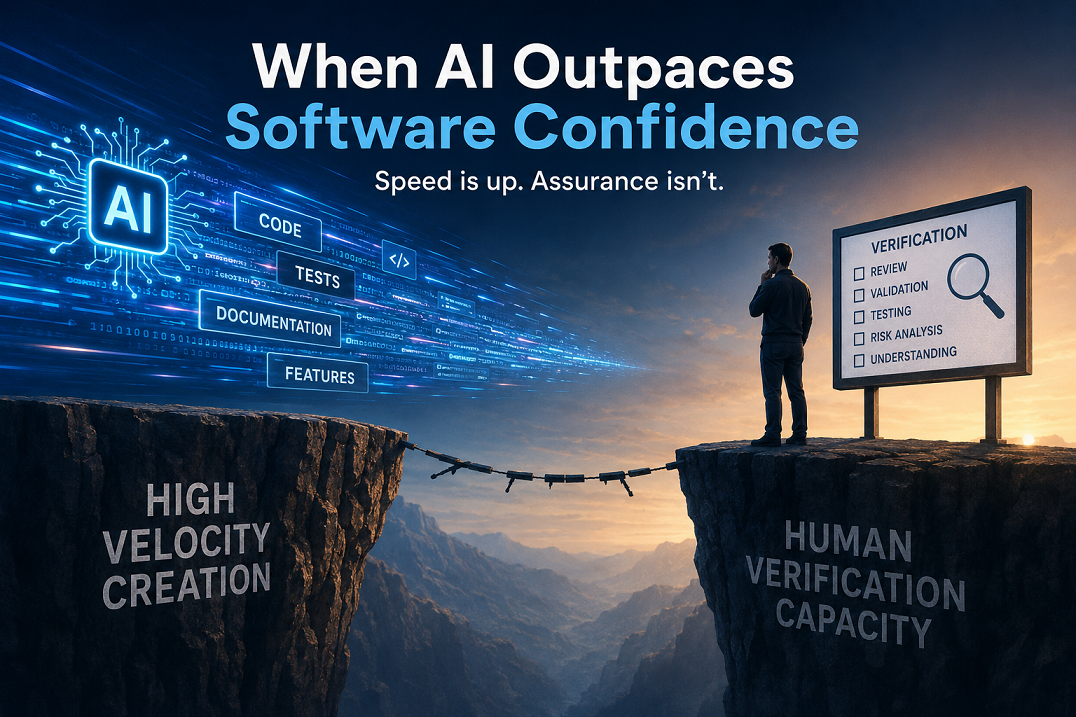
Artificial intelligence is simply the latest and most powerful acceleration mechanism. Developers can now generate code, documentation, test cases, and even entire feature implementations in a fraction of the time that was previously required. The productivity gains are real. Anyone who claims otherwise is ignoring what is happening across the industry. Yet amid the excitement surrounding AI-assisted development, a less obvious question is beginning to emerge. If software creation is becoming dramatically easier, what happens to the process of verifying that software?
The answer may be uncomfortable. While our ability to generate software is accelerating rapidly, our ability to build confidence in that software is not increasing at the same rate. In some cases, it may even be falling behind.
This is not a new problem. In many ways, it is an evolution of themes we explored in The AI Testing Hangover and Evaluating AI Generated Tests. Those articles examined the growing tendency to mistake activity for assurance. More automation does not automatically create more confidence. More tests do not automatically create better coverage. More output does not necessarily mean better quality. AI is now forcing the industry to confront the same reality on a much larger scale.
One of the assumptions embedded in modern software development is that verification will naturally scale alongside production. Historically, that assumption was mostly reasonable. If a team doubled its development capacity, it could usually increase its testing efforts as well. Additional engineers, better automation, and improved tooling helped maintain a workable balance between creating software and validating it. AI changes that equation because it allows software production to grow much faster than human understanding.
Consider a common scenario. A developer uses an AI assistant to generate a new feature. The tool suggests implementation details, writes supporting functions, creates unit tests, and produces documentation. Everything appears to be moving efficiently. The resulting pull request may contain hundreds or even thousands of lines of code, accompanied by dozens of generated tests. The question is not whether this can be done. It clearly can. The question is whether the team reviewing that change truly understands what it is approving.
The bottleneck in many software organizations is no longer writing code. Increasingly, the bottleneck is understanding code. It is determining whether a generated implementation actually solves the intended problem. It is validating whether the generated tests verify meaningful behavior rather than merely exercise implementation details. It is identifying assumptions, edge cases, risks, and unintended consequences that may not be obvious from a quick review.
Human attention remains finite. Human judgment remains finite. Human expertise remains finite. AI has expanded production capacity without expanding any of those resources. The result is a growing imbalance between the volume of software being created and the amount of thoughtful verification that can be applied to it.
The Illusion of Test Coverage at Scale
This challenge is particularly visible in testing. For years, software teams struggled with insufficient test coverage. Today, some organizations are encountering a very different problem. Test creation has become so inexpensive that teams can generate large volumes of test cases with minimal effort. On the surface, this appears to be progress. Coverage numbers increase. Test repositories grow. Dashboards show more green indicators than ever before.
Yet quantity has always been one of the least reliable indicators of software quality. A test suite containing ten thousand tests can still miss a critical business risk. A coverage report showing impressive percentages can still fail to reflect how real users interact with a system. An AI-generated test may successfully verify that a function behaves exactly as implemented while completely missing the fact that the implementation itself is solving the wrong problem.
In The Age of the Test Critic, we argued that the future of testing may involve less effort spent generating tests and more effort spent evaluating them. That idea becomes even more relevant in an AI-driven environment. When test generation becomes abundant, the scarce resource is no longer test creation. The scarce resource becomes judgment.
This distinction is important because confidence and testing are not the same thing. Testing is an activity. Confidence is an outcome. A product can pass every test that was designed for it and still fail in production. The purpose of testing has never been execution alone, but reducing uncertainty and improving understanding.
The irony of the current moment is that AI is solving some of the easiest problems in software development while amplifying some of the hardest ones. Generating code is becoming easier. Generating tests is becoming easier. Producing artifacts is becoming easier. Understanding whether those artifacts deserve trust remains difficult.
This is why traditional productivity metrics may become increasingly misleading. Measuring lines of code becomes less relevant when code can be generated instantly. Counting test cases becomes less meaningful when hundreds can be created in minutes. Even execution speed loses some of its value when running tests is no longer the primary constraint.
What matters instead is whether teams can effectively verify what they create. Can they identify meaningful risks before release? Can they distinguish between activity and assurance? Can they explain why they trust a release rather than merely reporting that it passed? These questions are more difficult to answer than traditional metrics, which is precisely why they matter
The coming years may reshape how software organizations think about quality. For decades, the challenge was creating software efficiently. AI is rapidly reducing that constraint. The next challenge is verification at scale. As software generation becomes increasingly automated, competitive advantage may shift toward organizations that can evaluate, validate, and understand their systems most effectively.
The companies that thrive will not necessarily be the ones producing the most code or generating the most tests. They will be the ones capable of transforming information into confidence. They will understand that quality is not measured by the volume of artifacts flowing through a pipeline, but by the degree to which teams can trust the software they release.
Confidence Is Becoming the Scarce Resource
The software industry has spent years optimizing for production. AI is accelerating that trend to levels that would have seemed unrealistic only a few years ago. Yet every technological shift eventually reveals a new constraint, and software development appears to be approaching one now. The challenge is no longer whether we can create more software. The challenge is whether we can meaningfully verify what we create before complexity outpaces our ability to understand it.
In a world where code generation becomes abundant, confidence may become the most valuable asset a software team possesses. The organizations that recognize this shift early will be far better positioned than those that continue measuring success solely by how much software they produce.