
Blurring Boundaries in DevOps: The Rise of TestOps

The deployment went live at 3 a.m., and for a brief moment, everything seemed perfect. Dashboards showed all systems green, the logs scrolled neatly, and the DevOps team finally exhaled. Then, just as they were about to log off, support alerts started pouring in. The application was behaving unpredictably, and users were already reporting failures. The culprit was simple yet critical: a missing configuration update in the test environment that no one had noticed. The tests had passed, but they had not reflected the real deployment conditions.
That moment captured a growing truth in modern software delivery. Even in mature DevOps pipelines, a silent divide persists between operations and testing. Continuous delivery may be automated, but quality assurance often lags behind. To close this gap, a new discipline is emerging within forward-thinking engineering teams: TestOps.
The Invisible Divide in DevOps
DevOps reshaped how teams deliver software, making it faster, more automated, and more collaborative. Yet, despite all the gains in speed and reliability, testing frequently remains isolated. While deployment and infrastructure are tightly orchestrated, test execution and maintenance often exist in a separate, less integrated workflow. As a result, when failures occur in production, teams sometimes realize that testing was never truly part of the delivery lifecycle.
Continuous integration and delivery were meant to unite developers and operations, but QA was sometimes left orbiting around them. DevOps is about shared ownership, and testing must now join that shared responsibility. This is where TestOps finds its purpose, turning testing into a dynamic, operational process rather than a static verification step.
What Exactly Is TestOps?
TestOps is the natural evolution of QA in the DevOps era. It is the fusion of testing practices with operational excellence. In practical terms, TestOps manages how tests are planned, orchestrated, executed, and analyzed within the continuous delivery pipeline. It ensures that testing is not just a gatekeeper before release, but a continuous, integrated service that operates across environments and stages.
While traditional QA focuses on test design, execution, and results analysis, TestOps adds layers of operational intelligence. It involves environment management, resource provisioning, and the automation of infrastructure that supports testing at scale. A TestOps engineer treats test environments as code, manages test data dynamically, and ensures that test execution integrates seamlessly with CI/CD workflows.
TestOps also emphasizes observability. It connects pre-release test data with post-release monitoring metrics, enabling a closed feedback loop between QA and production. This alignment allows teams to understand not only what failed, but why, and how it affects end users. In other words, TestOps brings testing into the same ecosystem of automation, observability, and feedback that DevOps built for deployment.
At its core, TestOps answers a critical question that has long challenged software organizations: How can we make testing as agile, scalable, and measurable as the rest of the delivery process? The answer lies in treating testing as an operational function, supported by automation, analytics, and continuous learning. It is testing without walls, fully aligned with the rhythm of DevOps.
The Driving Forces Behind TestOps
Several industry trends are pushing teams toward TestOps. The explosion of microservices, cloud-native applications, and multi-environment testing has made manual coordination impossible. Continuous delivery pipelines require automated provisioning of test environments, synchronized data, and scalable execution. At the same time, organizations demand faster feedback cycles without sacrificing quality or compliance.
Another major factor is the rise of AI and analytics in testing. TestOps leverages these technologies to optimize test selection, detect redundant suites, and predict high-risk areas based on code changes and production behavior. It transforms testing into a continuously improving process rather than a repetitive one.
TestOps in Practice
In a mature TestOps setup, every part of testing is automated and observable. When a developer pushes new code, a TestOps pipeline automatically provisions a test environment, seeds it with relevant data, and triggers the appropriate test suites. Results flow directly into dashboards shared by development, QA, and operations. Failures can be traced to specific commits or environment configurations. The same data that supports pre-release testing is later used to compare against production metrics, closing the quality loop.
This orchestration eliminates the delays and inconsistencies that once plagued release cycles. It ensures that tests run in relevant conditions and that feedback is immediate and actionable. When coupled with predictive analytics, TestOps can even recommend which tests to prioritize based on risk and recent changes.
AI as a Catalyst for TestOps
Artificial intelligence amplifies the effectiveness of TestOps. It analyzes massive volumes of test results, production telemetry, and system logs to uncover hidden patterns. AI can identify areas of instability, detect redundant tests, and optimize regression cycles by focusing on the most impactful scenarios.
AI also enhances data generation and maintenance. Using advanced pattern recognition, it can create realistic synthetic datasets that match production behavior without exposing private information. It can even predict which datasets will uncover specific classes of defects. Yet, as powerful as AI becomes, human insight remains essential. TestOps teams must interpret AI-driven recommendations carefully, ensuring that automation aligns with context and business goals.
Shifting Roles and Responsibilities
TestOps changes the roles of everyone involved in the software lifecycle. Testers evolve into hybrid engineers who understand infrastructure, automation frameworks, and CI/CD pipelines. Developers learn to see testing as part of system reliability. Operations specialists incorporate quality metrics alongside performance and uptime metrics.
This convergence creates cross-functional teams with shared accountability. Instead of passing work between silos, they collaborate on a continuous flow of quality assurance. The result is not only faster releases but more predictable and measurable outcomes.
The Role of Test Management
Modern test management tools are at the heart of TestOps. They serve as the command center where automation, analytics, and collaboration intersect. A platform such as Testuff can integrate with CI/CD systems, link test results with code commits, and visualize quality trends over time. This connection transforms test management from an administrative function into a strategic one.
By correlating test data with operational insights, Testuff allows QA and DevOps teams to make data-driven decisions about quality, coverage, and risk. The result is not just better reporting, but a continuous understanding of product stability throughout its lifecycle.
Challenges and Cultural Shifts
Adopting TestOps requires more than new tools. It demands a cultural shift where teams embrace shared ownership of quality. It may start small, perhaps by integrating test management with CI/CD pipelines, but the long-term goal is full automation and visibility. Every stage of delivery must treat testing as a built-in activity, not an external step.
Overcoming resistance can take time. Teams accustomed to working in isolation need to adapt to transparency and collaboration. The reward, however, is significant: a system where failures are found earlier, environments remain consistent, and releases flow smoothly without last-minute surprises.
The Future of TestOps
Looking ahead, TestOps will continue to evolve alongside AI, observability, and continuous verification. We will see intelligent pipelines that dynamically adjust test scope based on code risk, test coverage, and live performance data. QA will move closer to production, constantly validating real-world scenarios with minimal human intervention.
The boundary between testing and operations will fade until quality becomes an inherent property of the delivery system. In that future, TestOps is not an experiment. It is the foundation of continuous quality.
A New Rhythm of Collaboration
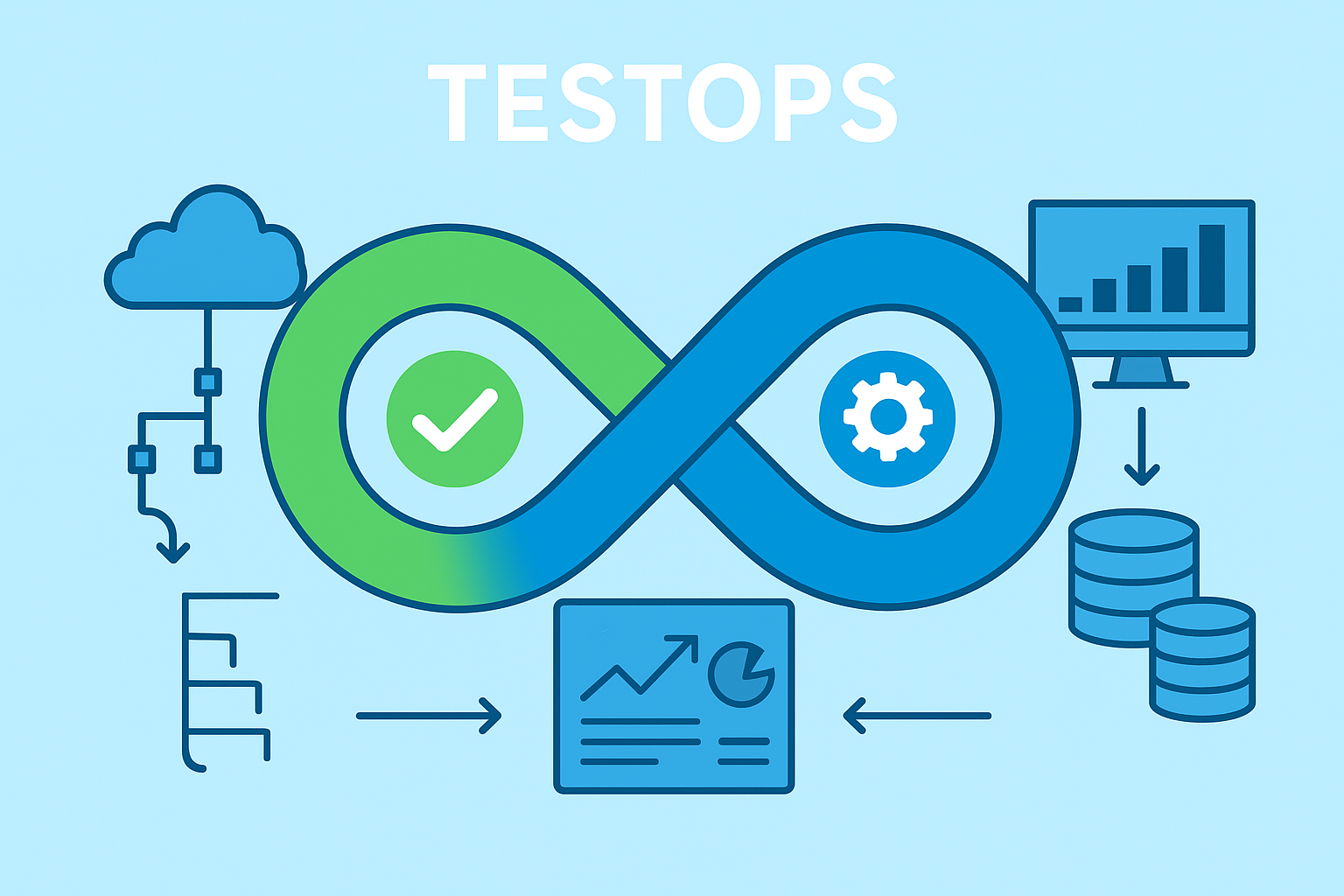
Back at that 3 a.m. deployment, imagine a different scenario. The environment is automatically provisioned, the variables are verified, and the tests are executed in perfect sync with the latest deployment. The QA engineer is part of the TestOps team that watches the same dashboards as the developers. The issue never reaches production because it is caught in the loop that now unites them all.
That is the vision of TestOps. It is testing that moves at the speed of delivery, adapts as systems evolve, and ensures that quality is not inspected in, but built into every release.