
For thirty years, the entire discipline of automated testing lived inside a comfortable binary truth. You provided a specific input, you dictated an exact expected output, and you commanded the machine to compare them. If a single character deviated, the test failed. It was clean, unforgiving, and perfectly suited for deterministic code.
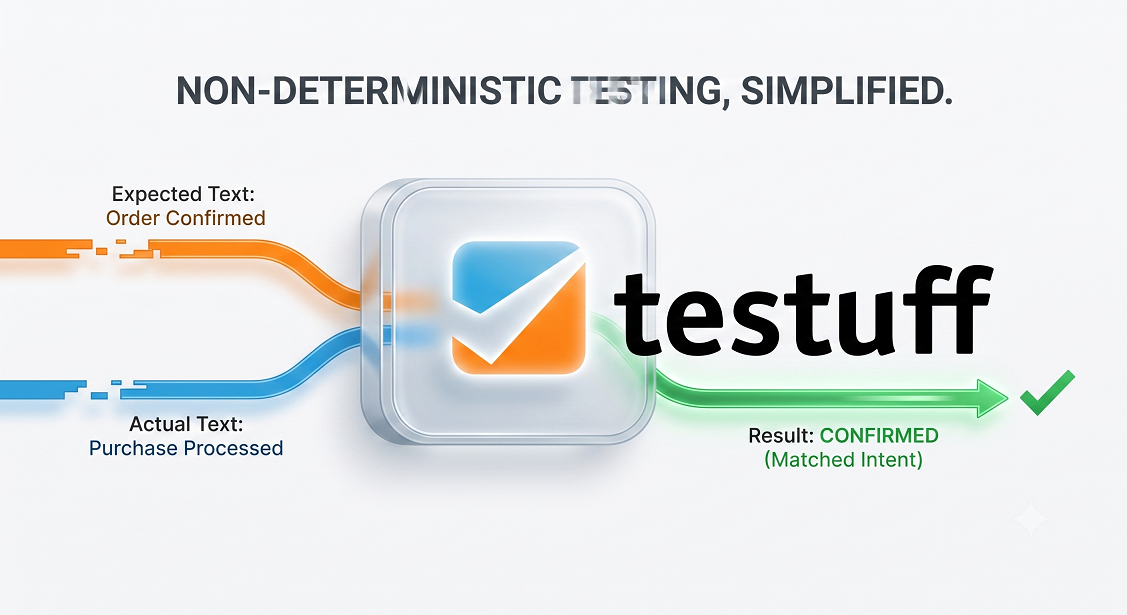
But walk into any engineering team today and you will witness a strange new ritual. A quality assurance engineer sits staring at a failed automated run where the expected string was “Your order is confirmed” and the actual string returned by an LLM infused feature was “We have successfully processed your purchase.” The feature worked perfectly. The user experience was flawless. The business intent was completely satisfied. Yet the test suite is flashing a brilliant, urgent red.
This is the silent crisis of modern software testing. We are attempting to police a probabilistic world using deterministic handcuffs. As software applications move away from rigid procedural execution and toward dynamic, generative behavior, our traditional verification frameworks are collapsing under the weight of false positives. It is no longer just about catching defects. It is about surviving the noise of benign variation.
In our previous discussions regarding The Age of the Test Critic, we looked at how the sheer volume of AI generated coverage forces testers into an editorial role. But the crisis goes deeper than human oversight. The underlying mechanics of how software testing tools evaluate success must evolve. If our code is no longer binary, our assertions cannot remain binary either. We are witnessing the slow, necessary death of the binary assert.
The Tyranny of the Rigid Expectation
Traditional automated testing scripts are inherently fragile because they assume the software will always choose the exact same path to reach a destination. This mental model works perfectly when a database query returns a fixed array or when a mathematical calculation results in an absolute integer. It falls apart completely when the system uses a large language model to synthesize data, personalize a user interface, or interpret natural language inputs. When software acts with a degree of agency, the output becomes fluid.
If you run the same automation script ten times against a generative search feature, you might get ten different phrasing variations. None of them are incorrect, but to a standard test runner, nine of them are systemic failures. This creates an immediate operational bottleneck. Software testing teams find themselves spending more time adjusting hardcoded string verifications than fixing actual regressions. The automation illusion we warned about in past posts becomes a loop of endless maintenance, transforming your software test management suite into an alert factory instead of a genuine source of team confidence.
When test automation tools are reduced to checking for literal text matches, they miss the forest for the trees. A feature can pass a rigid regex check while completely hallucinating the underlying financial data. Conversely, it can provide flawless data while failing a test because it used a synonym. This fragility destroys trust in automation. When engineers see a red dashboard, their initial reaction should be alarm, not an annoyed sigh that the AI changed its wording again.
Shifting from Matches to Tolerances
To resolve this conflict, software testing must borrow a concept from data science: semantic tolerance. Instead of asking whether the output matches an exact sequence of characters, testing tools must begin asking whether the output falls within an acceptable boundary of intent. This means replacing the absolute true or false statement with a contextual confidence score.
This shift changes what we actually document within our test management platforms. A test case can no longer look like a static blueprint. It becomes a profile of acceptable behavior. If a feature generates an executive summary of a financial report, the test script cannot check for specific sentences. Instead, it must programmatically verify that the summary contains key financial metrics, avoids restricted vocabulary, and maintains a neutral sentiment. We are no longer checking if the machine said the exact words we expected; we are checking if the machine respected the guardrails we established.
Evaluating quality along a spectrum of tolerance requires new metrics. We must train our automated testing tools to evaluate semantic similarity using vector distances rather than string comparisons. This approach allows the test suite to remain robust even when the application language fluctuates. By focusing on intent preservation rather than character matching, quality assurance processes can finally keep pace with rapid development cycles without triggering constant false alarms.
Operationalizing the Probabilistic Test Suite
How do we actually build this architecture without drowning in complexity? It requires test management software to act as an orchestrator of heuristic evaluations rather than a simple log of binary execution. Modern testing tools must integrate semantic layers directly into the CI CD pipeline, allowing engineers to write assertions based on patterns, proximity, and contextual logic.
When designing a test suite for a nondeterministic system, the verification strategy requires a complete restructuring of the validation layer. Here is how modern quality assurance teams are redefining their verification checkpoints:
- They replace literal string comparisons with vector embeddings to calculate semantic similarity scores.
- They introduce structural validation that checks for JSON schema consistency rather than specific content placement.
- They deploy LLM assisted judges within the pipeline to evaluate qualitative attributes like tone and readability.
- They run differential testing cycles where multiple variations of an AI response are compared against each other to detect extreme variations.
- They establish behavioral boundaries by feeding adversarial inputs to check if security guardrails remain intact.
By embedding these flexible validation layers into our regular testing cycles, the role of automation changes. It stops being a digital trapdoor that trips over harmless language variations and becomes an intelligent filter that alerts the team only when the system drifts outside its functional mission. This methodology protects the team from alert fatigue while ensuring that structural errors are caught immediately.
The New Architecture of Confidence
We have spent years optimizing for delivery speed, but as we noted in When AI Outpaces Software Confidence, speed without understanding is a liability. If our test suites remain trapped in a rigid binary mindset while our applications become organic and fluid, we will inevitably abandon automation altogether out of sheer frustration. The solution is not to write fewer tests or to accept lower quality software. The solution is to build a more mature relationship with system uncertainty.
The future of software testing relies on our ability to design tools and processes that mirror the complexity of the systems we build. When we stop demanding that software act like a simple pocket calculator, we can finally begin to validate its true value. Confidence in the age of generative engineering will not be found in a pristine wall of green checkboxes that never change. It will be found in test suites that know how to read between the lines, separating harmless creativity from genuine system failure.