
When Confidence Blinds Us: Lessons from a Simple Typo
I’ve recently noticed a post from James Bach on LinkedIn that perfectly captures a subtle but pervasive problem in both software testing and everyday work. He described discovering, after publishing his book, that there was a typo in his own email address. A missing “s” that slipped through multiple reviews, including his own. It wasn’t that the mistake was buried in complex technical material. It was sitting there in plain sight, but he didn’t look at it closely enough because he knew it was right. Or at least, he thought he did.
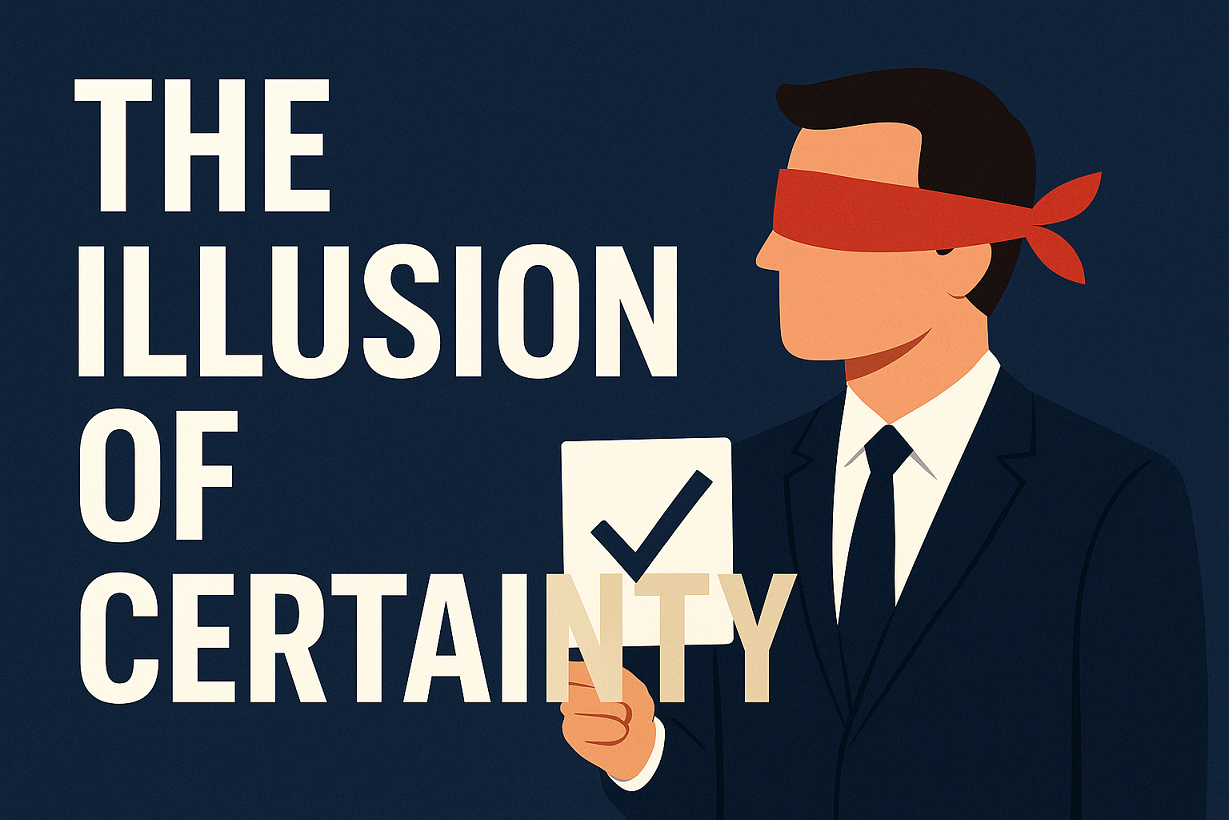
It’s such a small example, but it highlights something deep and universal. The phenomenon he describes deserves a name, as he himself claims in the post. It’s the moment when we trust something so much that we stop testing it. When confidence itself becomes a kind of blindfold.
This happens constantly in testing, but also in writing, design, management, and even relationships. It’s the reason people overlook typos in titles, publish broken links, or ship software with obvious bugs in areas “nobody thought could be wrong.” It’s not laziness, and it’s not incompetence. It’s human psychology.
When something feels certain, our brains switch modes. We move from active inspection to passive assumption. In testing terms, we stop exploring and start assuming coverage. The risk feels low, so attention drops. We unconsciously conserve cognitive energy for what seems more complex or risky. Unfortunately, that’s exactly when the simplest things can go wrong.
The Power of Assumption
James Bach, a respected voice in the testing community, has always emphasized the importance of critical thinking and questioning assumptions. His story about the typo perfectly illustrates how hard it is to apply that mindset to ourselves. Even someone who literally wrote the book on testing can fall into this trap. And that’s what makes the story so powerful.
It reminds me of how airline pilots or surgeons use checklists. They know their jobs inside out, yet they still verify every step. They don’t rely on memory or familiarity, because they understand how dangerous “obvious” mistakes can be. In testing, we need a similar discipline, a way to protect ourselves from our own confidence.
The Science Behind Missing the Obvious
One of the most fascinating aspects of this phenomenon is how it interacts with perception. When we expect something to be correct, our brain literally sees it as correct. This is a well-documented cognitive bias known as confirmation bias. We look for evidence that supports what we already believe, and we unconsciously ignore small signals that contradict it.
That’s why authors can read the same typo a dozen times and never notice it. Their brain fills in the missing letter automatically.
The same thing happens in testing. Imagine you’re verifying an input form that has always worked perfectly. You run through the test steps, glance at the results, and everything seems fine. But maybe the validation message is slightly wrong, or the success state doesn’t trigger under one rare condition. If you’re not truly looking, you won’t see it because part of you already decided that area is safe.
The Silent Enemy: Overconfidence
Overconfidence is the quiet enemy of quality. It hides behind experience, speed, and even professionalism. The more we trust our processes or our expertise, the easier it becomes to skip verification. Ironically, it often strikes the most experienced professionals.
Novices tend to double-check everything because they don’t yet trust themselves. Experts, on the other hand, rely on intuition and intuition is usually right, until it isn’t.
How We Counter It
The first step is awareness. Simply recognizing that overconfidence exists changes the way we look at our work. When I read James Bach’s story, I immediately thought of moments when I’ve done the same. Times when I skimmed through a final proof or a “simple” test, convinced nothing could be wrong, only to find later that something obvious had slipped through.
The second step is designing habits that compensate for human bias. Testing is as much about testing the tester as it is about testing the system. If you know you’re prone to overlooking the “obvious,” then you can deliberately introduce small rituals to slow yourself down.
For example, when reviewing text or code, changing the environment can make a big difference. Reading out loud, changing fonts, or reviewing in print can all disrupt your automatic perception and force you to actually see what’s in front of you. In software testing, pairing with another tester or using exploratory techniques can reveal blind spots you didn’t know you had.
Another strategy is to treat every assumption as a hypothesis, not a fact. Instead of saying “this part works,” say “I believe this part works, and I’ll try to prove myself wrong.” It’s a small linguistic shift, but it rewires your mindset.
A Lesson in Humility
And of course, humility plays a role. Mistakes like a typo in an email address are humbling precisely because they’re so ordinary. They remind us that no one is immune to human error. The best testers, writers, and leaders don’t try to eliminate mistakes entirely but they build systems and cultures that make it easier to catch them early.
James Bach’s reflection also points to something else: the emotional side of error. When we find out we’ve made a simple mistake, especially in something public like a book, it’s easy to feel embarrassed. But those moments can be the most valuable. They teach us about our own blind spots and, if we’re open about them, they help others see that even experts are fallible.

The Illusion of Certainty
If I had to name this phenomenon, I might call it “the illusion of certainty.” It’s what happens when confidence replaces curiosity. When the surface of something seems so smooth that we stop probing it. It’s an illusion because certainty doesn’t exist in testing, or in life. Everything can be questioned, even the things that look obvious. Especially those.
So next time you’re reviewing a piece of work, whether it’s a line of code, a design layout, or an email address in a book, pause for a second and ask yourself: “What am I assuming here? What haven’t I checked because I think I don’t need to?” That small moment of awareness might save you from a bigger mistake.
That’s what makes James Bach’s story resonate so strongly. It’s not just about a typo. It’s about the mindset that leads us to miss it. It’s a gentle reminder that even experts need to test the things they’re sure about, because in the end, the most dangerous bugs are often the ones we’re too confident to look for.